The retry storm that ate 40,000 messages
2 a.m.
An API token expired overnight. That was the whole root cause: one credential, for one third-party API, reached the end of its life while nobody was looking.
The consumer that depended on it was not careless code. It was built the way the tutorials and the postmortems say to build one. It caught exceptions and logged them with a stack trace. It retried, with a limit, so no message could go around forever. Past the limit, the broker dead-lettered the message instead of dropping it. By every checklist I knew, it was a well-built consumer.
It did exactly what it was built to do. Every message called the API, was refused, logged an error, went back on the queue, and tried again. Each message found out about the expired token on its own. Each one used up its retries on its own. Then each one went to the dead-letter queue, on its own.
By morning the dead-letter queue held 40,000 messages, and every one of them was customer data that should have reached the vendor and hadn't. Technically nothing was lost. But nothing had been done either, and the recovery was manual: fix the token, move the messages back by hand, and hope nothing else had landed in that queue for a different reason.
What stayed with me afterwards wasn't the token. Tokens expire. It was that the system had the information it needed to stop after the first failure, and no part of it was in a position to use it. Every message failed for the same reason, and every message was treated as if its failure were its own.
The usual fix is a hand-rolled circuit breaker for that one consumer. Then the next consumer needs one, and each is slightly different from the last. This article is about the version I'd want instead, and the reference implementation I built for it: Traction, open source, running on a laptop with Docker. Every measured number below comes from its included demo, not from that night.
The failure has three sizes
A queue consumer calling a third party sees one thing when a call fails: an exception. But that exception can mean three very different things, and the right response to each is different.
- One bad record. A contact with an invalid email address. Retrying it will never work, and it says nothing about the next message. The right move is to reject it and keep going.
- One broken endpoint. The vendor changed the contract for company records. Every company sync fails, while contact syncs against the same vendor are fine. The right move is to stop company syncs, keep the work, and let contacts carry on.
- The whole connection. The token expired. Every call of every kind fails, and will keep failing until a human does something. The right move is to stop everything on the first failure and keep every message until that human is done.
One flight
One contact has an invalid email
- Hits
- that one contact
- Right move
- record it, keep going
One gate
The company endpoint changed its contract
- Hits
- every company sync; contacts are fine
- Right move
- stop that gate, keep its work
The whole airport
The token expired
- Hits
- every call to acme, of every kind
- Right move
- ground-stop the airport, keep everything
A retry policy can't tell these apart. It sees one exception at a time, in one consumer thread, on one pod. A retry count, a backoff schedule and a dead-letter queue are all per-message tools, so they apply the per-message move to all three sizes: try again, then give up. For the bad record that's harmless waste. For the broken endpoint it's an alert per message. For the dead token it's the storm.
Some failures aren't a size at all. A timeout, a 5xx blip or the vendor throttling you says "not right now", not "this is broken". Those deserve a pause or a backoff, and retries are the right tool for them, which is part of why retries get used for everything else.
The important thing about the three sizes is where they come from. Whether a failure is record-sized, endpoint-sized or connection-sized is a property of how your work depends on the vendor, not of the exception's class name. An expired token is connection-sized for every consumer that shares it. A changed endpoint is sized to the work that calls it. That means the size can be declared once, up front, instead of rediscovered by every message.
Acting on it needs shared state. One consumer thread can't see that three different company records failed the same way in five minutes, across every pod: that takes a shared counter. Stopping every pod at once takes a shared status, and pacing every pod to one vendor quota takes a shared rate limit. Then someone has to notify a human once, not once per message, and give them a way to resume. That's a lot of plumbing to write per consumer. The problem page walks the three sizes through two complete examples.
Think airports, not retries
I needed words for the three scopes that weren't "service", "queue" and "message", which all mean something else already. I ended up with an airport.
An airport is one governed dependency: one shared quota, one credential set, one outage fate. A gate is one independently stoppable work type on that dependency. A flight is one message. In the demo, a CRM account is the airport, contact sync and company sync are its gates, and each queued sync is a flight:
airport  crm:acme        one quota, one credential, one outage fate
├── gate  contact-sync   one work type, stoppable on its own
│   └── flights          one message each
└── gate  company-sync
    └── flights
The containment rule follows from the nesting: a stop at one level never touches its
siblings. Stopping company-sync leaves contact-sync landing. Stopping the airport stops
both. Rejecting one flight stops nothing.
The other word that matters is ground stop. When an airport is ground-stopped, its consumers stop taking work, and the work stays on the runway, the airport's queue. Nothing retries, nothing dead-letters, nothing calls the vendor. When a human reopens the airport, the flights take off again, paced by the shared rate limit.
That is the whole difference: a retry policy's unit is the message, and it gives up on the message. A ground stop's unit is the scope, and it stops the line but keeps the work.
The aviation words are a memory hook, not an entry fee. Every term has a plain-words alias in
the glossary, and the code uses the same words as the docs, so a
GATE_FAULT in a log line means exactly what it means here.
What you write (all of it)
Here is the demo's CRM integration, the real code from
CrmAirportConfig.java,
trimmed for width. It has four pieces.
First, declare what you're protecting. This one bean is the airport: its id, its rate limit, its gates, and the two pieces of your own code it runs.
@Bean
AirportSpec crmAcme() {
    return AirportSpec.of("crm:acme")
            .slots(20, Duration.ofSeconds(1))   // the shared rate limit
            .gate("contact-sync")               // one stoppable work type
            .gate("company-sync")
            .pilot(this::land)                  // your work
            .reporter(this::report);            // your failure classification
}
Second, send work from anywhere in your system. The first argument to DispatchOptions is
the business id the work stays idempotent on, because delivery is at least once. The second
is for bulk runs and is null here:
tower.dispatch("crm:acme", "contact-sync", contact,
        new DispatchOptions(contact.id(), null));
Third, the pilot: your code that does the work for one flight. It makes the call and nothing else. It never touches the broker, never acks, never decides whether to retry.
private static final Map<String, String> PATHS =   // gate -> Acme endpoint
        Map.of("contact-sync", "/contacts", "company-sync", "/companies");

void land(Flight<?> flight) {
    acme.upsert(PATHS.get(flight.gateId()), flight.payload());
}
Fourth, the reporter: your code that says what an outcome means. This is where the three sizes live. Each failure is classified to the level it breaks, and that classification is the only containment logic you write.
FlightReport report(Flight<?> flight, Throwable t) {
    if (t == null)
        return landed();
    if (t instanceof AuthException)              // dead token: the airport stops
        return incident(AIRPORT_FAULT, Evidence.from(t));
    if (t instanceof ContractException)          // a streak stops this gate
        return incident(GATE_FAULT, Evidence.from(t));
    if (t instanceof BadPayloadException)        // bad record: rejected
        return incident(FLIGHT_FAULT, Evidence.from(t));
    if (t instanceof VendorUnavailableException) // blip: hold, then park
        return incident(TRANSIENT, Evidence.from(t));
    if (t instanceof RateLimitedException)       // throttled: pace down
        return incident(RATE_LIMIT, Evidence.from(t));
    return incident(INTERNAL, Evidence.from(t)); // our bug: hold, then park
}
The exception types are the demo's own; yours would be whatever your client throws, or an
HTTP status code. Evidence.from(t) keeps a bounded excerpt of what went wrong, so the
incident list and the notification can say why without a logging stack behind them.
That's the whole integration. Adding a second vendor means writing another spec, pilot and reporter: the code that is actually about that vendor. Everything else comes from the declaration. The queues are declared on your broker and the consumers started. The rate limit is enforced across every pod. The ground-stop and streak rules apply, and so do backoff, parking, replay and discard. Bulk runs are tracked to completion. Notifications fire, the dashboard shows the fleet, and an admin API covers every operator action.
What the framework does with it
Traction splits the work across two planes.
The data plane runs in every service that does work. For each flight it pulls from the runway, it checks the cheap things first: is the airport stopped, is the vendor throttling us, is this gate stopped, was this flight's bulk run aborted? Only then does it take a slot from the shared rate limit, call your pilot, and ask your reporter what happened. A stopped scope never burns a vendor call.
Then it settles the message, and there are only four ways out:
- Land. The message is acked and done: it landed, or it was a bad record and is rejected.
- Hold. A blip, or your own bug: the message goes to a holding queue with backoff (30 seconds, 2 minutes, 10 minutes for a blip; one 30-second hold for a bug) and comes back.
- Park. Past the hold budget, on a
GATE_FAULT, or on a stopped gate: the message waits for a human. Parked is recoverable, never counted as failed. - Defer. The airport is down or throttled: the message goes back to the tail of the runway, untouched. If the airport is down, the consumer pauses until a reopen; if it's throttled, the airport waits out one rate-limit window.
Every settled step is sent as a report to the control plane, which runs in one service.
It reads every report, keeps the streaks, and flips the statuses the data plane obeys. The
rules are short. The first AIRPORT_FAULT ground-stops the airport: a dead credential
doesn't need a quorum. Three GATE_FAULTs for three distinct records in five minutes stop
that gate. Five FLIGHT_FAULTs or INTERNALs for distinct records in five minutes stop the
gate too, because when every record is "bad", the records probably aren't the problem. A
landing clears its gate's streaks. A reopen is always a human's call; nothing reopens itself.
Status changes are compare-and-set, so any number of racing reports of the same expired token produce one ground stop and one notification. Then every consumer of that airport, on every pod, is told to pause.
The two planes never call each other. Reports travel as JSON messages on your message broker. Statuses live in a Redis-compatible store, and changes are announced over the store's pub/sub, with the stored status as the source of truth for any process that missed the announcement. There is no HTTP between the planes and no shared database. In the demo both run inside one Spring Boot app, because that's the simplest thing to start, but nothing requires it: the control plane can be its own service, and the governed services can be deployed and scaled independently of it and of each other.
Because the contract between the planes is JSON on the broker plus documented key shapes in the store, a data plane in another runtime is possible in principle. Java 21 and Spring Boot are what this repo ships, and nothing else is demonstrated in it. As a first check on that claim, a separate Python data plane interoperates with this repo's unmodified control plane.
The life of a flight has the step-by-step version, with a diagram of both planes and the full settle table.
The same outage, twice
The repo includes a demo that recreates the night from the start of this article, at a smaller scale, with a simulated vendor. Both scenarios run in Docker against the same broker, store and fake CRM. In both, the CRM's token has just expired and 1,000 contact syncs arrive.
The first scenario is the baseline: a plain @RabbitListener with a retry limit of 3 and a
dead-letter queue. That's the well-built consumer from the start of this article, written the
way most teams write it after their first incident. A retry limit of 3 means 3 redeliveries,
so 4 deliveries in all. Every message calls the dead API 4 times, logs 4 errors with stack
traces, and ends up in the dead-letter queue. Nothing notices that the failures share a cause.
The second scenario sends the same 1,000 messages through Traction. The first flight to
report AIRPORT_FAULT ground-stops the airport. Flights already in progress fail the same way
and go back to the runway tail. After that, nothing calls the vendor. Exactly one notification
goes out: a single traction.notify type=GROUND_STOP log line from the default hook, naming
the airport, the reason (AIRPORT_FAULT) and an evidence excerpt (AuthException | 401
with the vendor's token expired body).
All 1,000 flights wait on the runway. The script then fixes the token, sends one reopen
curl, and watches every flight land, paced at the airport's 20-per-second limit. It checks
that nothing is parked and nothing is dead-lettered.
A measured run of the included demo, on a laptop, ended each scenario with one result line. Here they are, wrapped for width, with the scenario labels added:
naive:
lost: 1000 · error lines: ~4000
recovery: manual

traction:
lost: 0 · notifications: 1
recovery: one curl
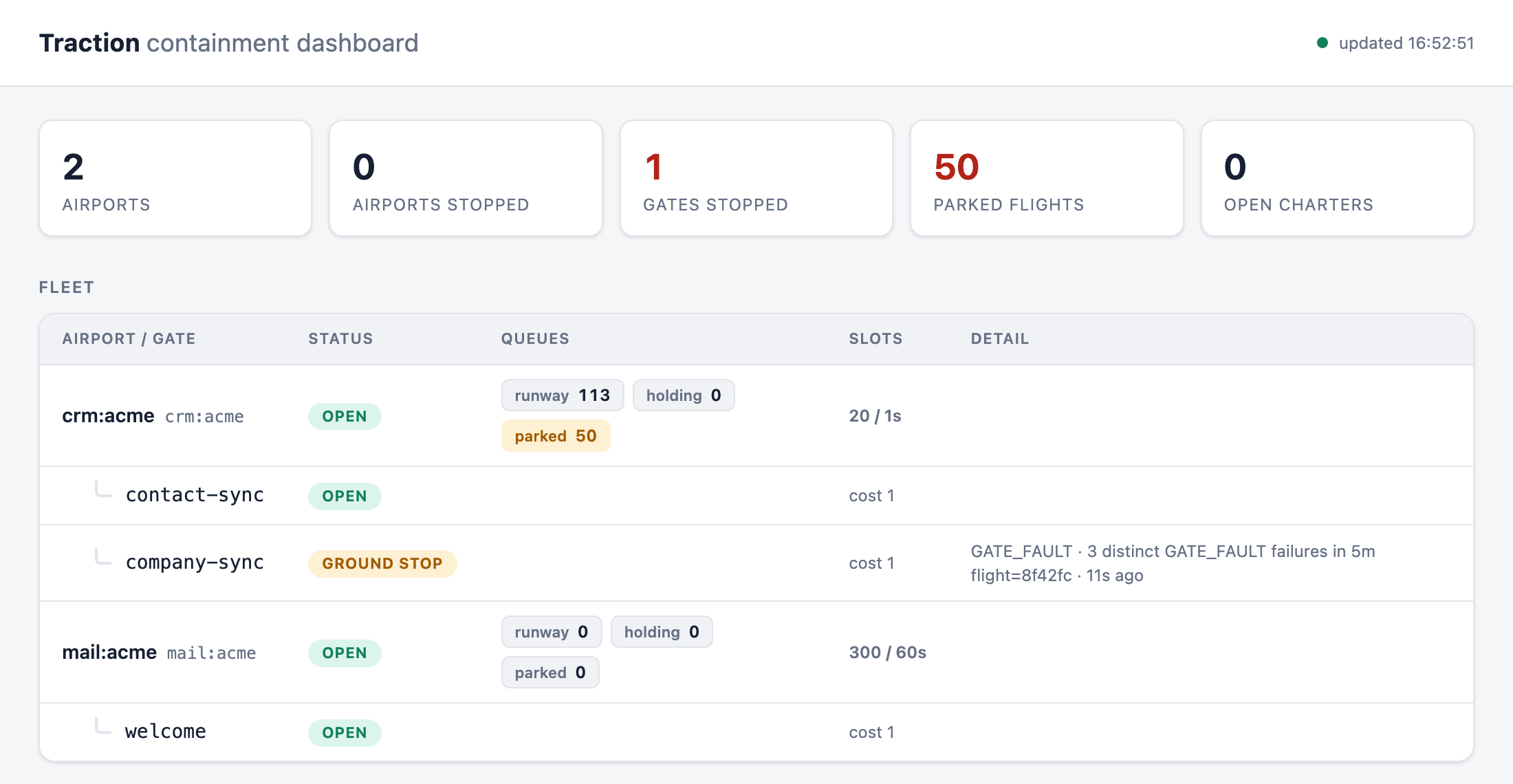
A frame frozen mid-run of scenario-gate.sh, the gate scenario, not the outage above: one gate is stopped on a contract change while its sibling keeps flying.
"Lost" on the naive side means dead-lettered: the messages still exist, but every one of them is now someone's manual job. Your numbers will vary with timing; the shape won't, and the scripts assert it, so a regression fails the run.
The naive consumer has no bug: it did what its configuration said, about 4,000 times. It just
had no place to put the knowledge that one failure meant all of them would fail. Traction has
exactly one place for it, the reporter's AIRPORT_FAULT, and the first report that uses it
ends the storm.
Day two: the operator's view
An outage has a second half: the morning after, when someone has to work out what state
things are in and put them right. Here, every operator action is one curl against the admin
API on the control-plane service, and every action is accounted for.
The token is fixed. Let the airport fly:
API=http://localhost:8080/traction/api
curl -X POST $API/airports/crm:acme/reopen
# {"airportId":"crm:acme","reopened":true}
A gate stopped on a streak works the same way, one level down. If the company endpoint had changed
its contract, company-sync would have stopped after three distinct failures, and its flights
would have parked while contacts kept landing. Once the integration is fixed, reopen the gate and replay what
parked:
curl -X POST $API/airports/crm:acme/gates/company-sync/reopen
curl -X POST $API/airports/crm:acme/replayParked
The order matters, and the docs say so: fix the cause, then reopen, then replay. Replaying into a stopped gate just parks the flights again, harmlessly.
Bulk runs, which Traction calls charters, get their own controls. A charter is a run dispatched against an expected count, so the framework can tell you how far along it is and when it's done. If a run turns out to be wrong halfway through, abort it:
curl -X POST -H 'X-Actor: dana' \
  $API/charters/mail:acme/welcome/run-1792774953/abort
The run's remaining flights are counted as skipped as they reach a consumer, and dropped without flying. They are accounted for but not kept, so redoing that work means dispatching it again from your source. When a charter completes, its books balance:
landed + rejected + skipped + parked + discarded == expected
Two things matter more to me than the curls themselves. First, nothing here silently loses work. Reopen and replay lose nothing; abort skips work on purpose, and counts it. The one action that drops work Traction still holds, discarding an airport's parked flights, requires an explicit confirm token, and anything else is a 400 that drops nothing. Second, the operator doesn't need a log search to know what happened. A stopped airport or gate carries a reason and an evidence excerpt, and the dashboard polls the same API. It has no buttons on purpose: the runbook is curl, so it can be pasted into a ticket.
The operations page is the full runbook, with every response body.
Why not a workflow engine / outbox / more retries
Three fair objections.
A workflow engine. Temporal and the other durable-execution runtimes retry failed steps, survive crashes, and can rate-limit work. If the work is a process, use one: several steps, compensation on failure, timers that run for days, a human approval in the middle. Traction has none of that, deliberately; its unit is one call to one dependency. The difference that matters here is shared fate. A durable runtime makes each step robust on its own. When the token expires, a thousand activities each discover it, each retry on their own policy, and each fail or wait in turn. You can build a circuit breaker around that, and then you're writing the containment layer this repo already is. They also compose: a workflow step can dispatch flights and let Traction contain the vendor. There's a longer comparison in why not Temporal?
The transactional outbox. The outbox solves a different problem: publishing a message reliably, in the same transaction as the database write that caused it. It gets the message onto the queue, and says nothing about what the consumer does when the vendor behind it is down. If you use one, keep it; Traction starts where it ends.
More retries, or smarter ones. Longer backoff, jitter, exponential schedules: all of them make each message wait longer before it discovers the same expired token. With 4 deliveries per message, the storm is 4 times the backlog. With a smarter schedule, it's the same storm, spread over more hours. A per-process circuit breaker is the closest thing, and it is the hand-rolled one mentioned at the start: it sees one pod's failures, it doesn't park work, and it gets written again for the next consumer. Retries stay in Traction, for the failures that really are "not right now".
What it costs, since build-versus-buy is the real question:
- Infrastructure: your message broker and a Redis-compatible store. The demo runs RabbitMQ with quorum queues and Valkey. If you already run both, there's no new box in your architecture diagram; if you don't, that's the bill.
- One control-plane service. One of your services sets a property and becomes the control plane. It hosts the rules, the admin API and the dashboard.
- Idempotent pilots. Delivery is at least once. A flight can arrive twice, so the pilot keys its writes on the business id you pass at dispatch.
- Your own auth. The admin API and the dashboard ship with no authentication in v1. Put them behind your own security, or off the public ingress, or both.
- A reference implementation, not a library. This is a runnable codebase to read, run and adapt. It's Java 21 and Spring Boot. The concepts come from production; the code is written to be lifted from.
The guarantees page states exactly what is promised, and lists the known limits of v1, each one a deliberate trade.
Run it
You need Docker. The images build with Gradle inside Docker, so you don't need a JDK; the scenario scripts use bash, curl and jq.
git clone https://github.com/dhananjaym-dev/traction.git && cd traction
docker compose up -d --build --wait
./demo/scenario-traction.sh
That's the governed scenario. ./demo/scenario-naive.sh runs the baseline,
./demo/scenario-gate.sh breaks one gate while the rest of the airport keeps flying, and
./demo/scenario-charter.sh aborts a bulk run part way through. Each resets the demo first. While they run, the dashboard is at
http://localhost:8080/traction. docker compose down -v removes everything.
If you want to go further than the demo, the docs read in this order:
- The problem: the three sizes, worked through twice.
- Concepts & glossary: every term and its plain-words alias.
- The life of a flight: both planes, step by step.
- Guarantees: what is promised, and the known limits.
- Operations: the admin API, notifications and configuration.
- Why not Temporal?: when a durable runtime is the better choice.
The code is at github.com/dhananjaym-dev/traction,
under the Apache 2.0 license. The reporter and the AirportSpec are the parts most worth
lifting into your own consumers, whether or not you use the rest.